А это мега проект от Greatness7 появившийся в 2026ом году (сам автор писал о 18-ти месяца работы над оным).
Сообщество (в лице уважаемого Greatness7), имея открытые исходные коды MGE и (новомодную) поддержку из (нейронок), взяло вяло переходящее знамя Свершений на себя и насвершало, торжественно:
MGE XE G7 fork
ver 20.xx
https://www.nexusmods.com/morrowind/mods/59957
Из основных стоит в первую очередь отметить:
- завоз поддержки
BC7 DDS формата текстур (которые до этого были доступны только для OpeMW). (сборка от 08 2026)
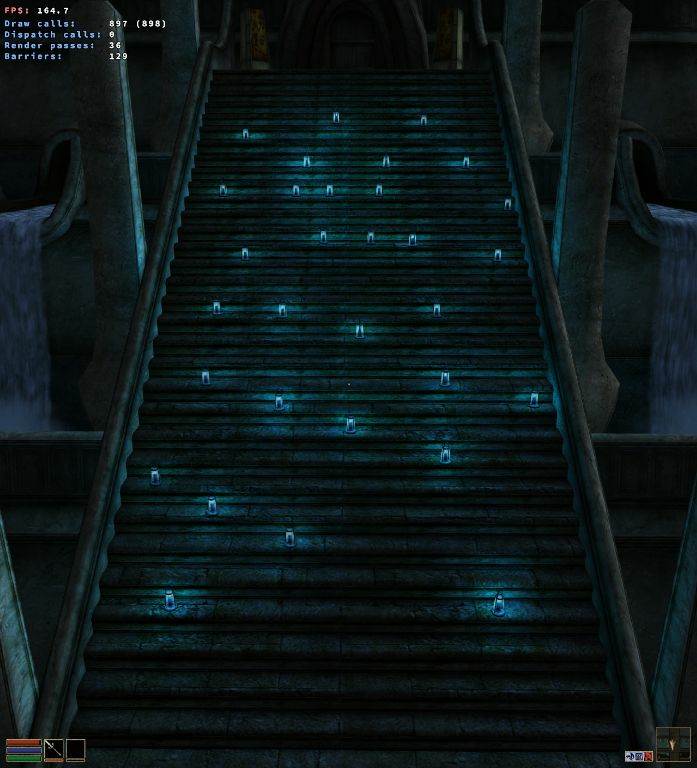
- поддержку 32х источников света на одну поверхность (в ванили 8х - включая глобальное освещение ячейки).
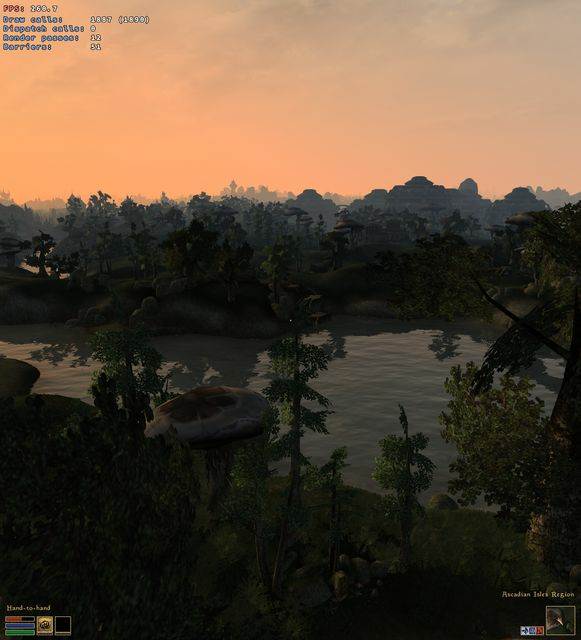
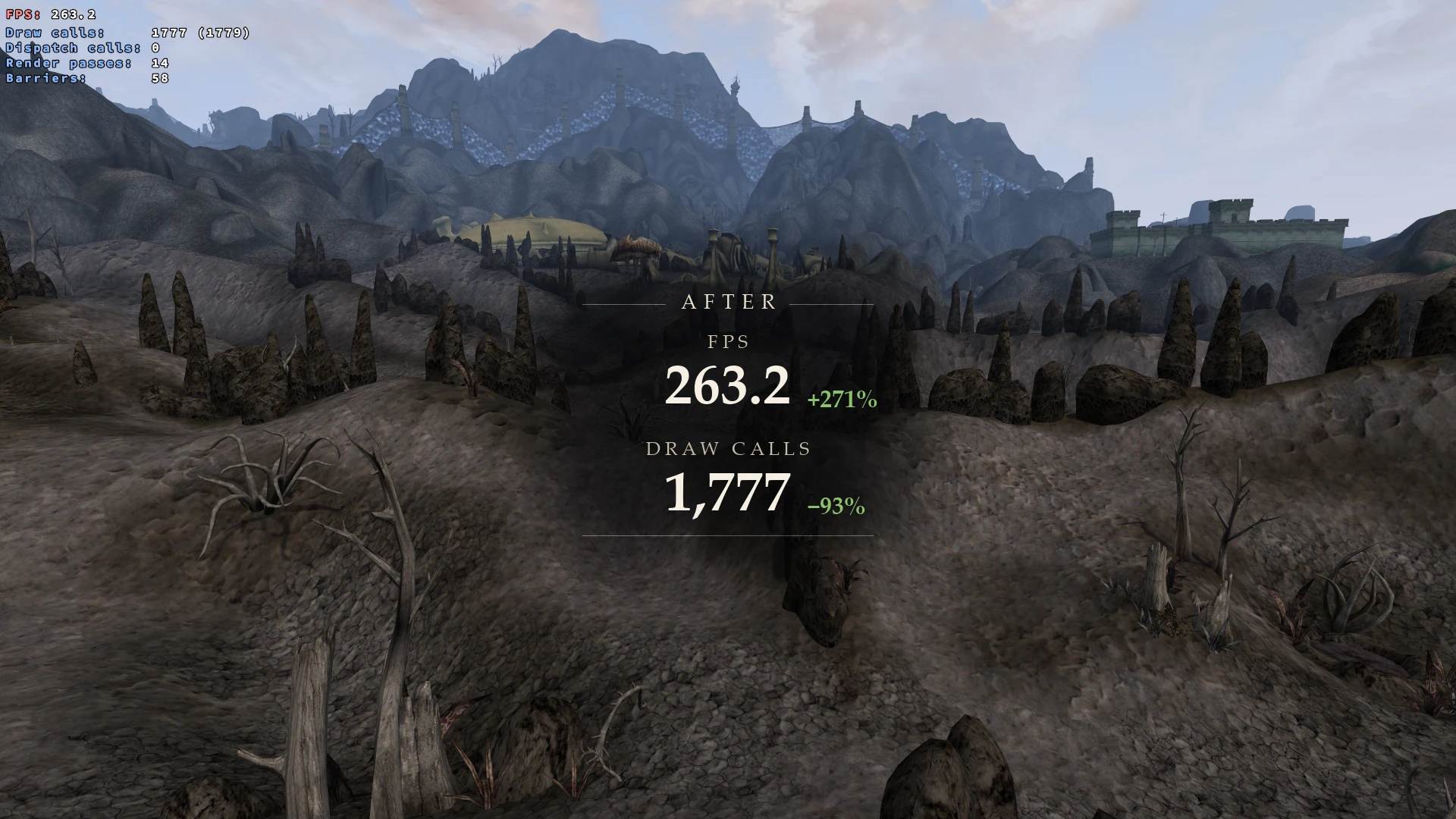
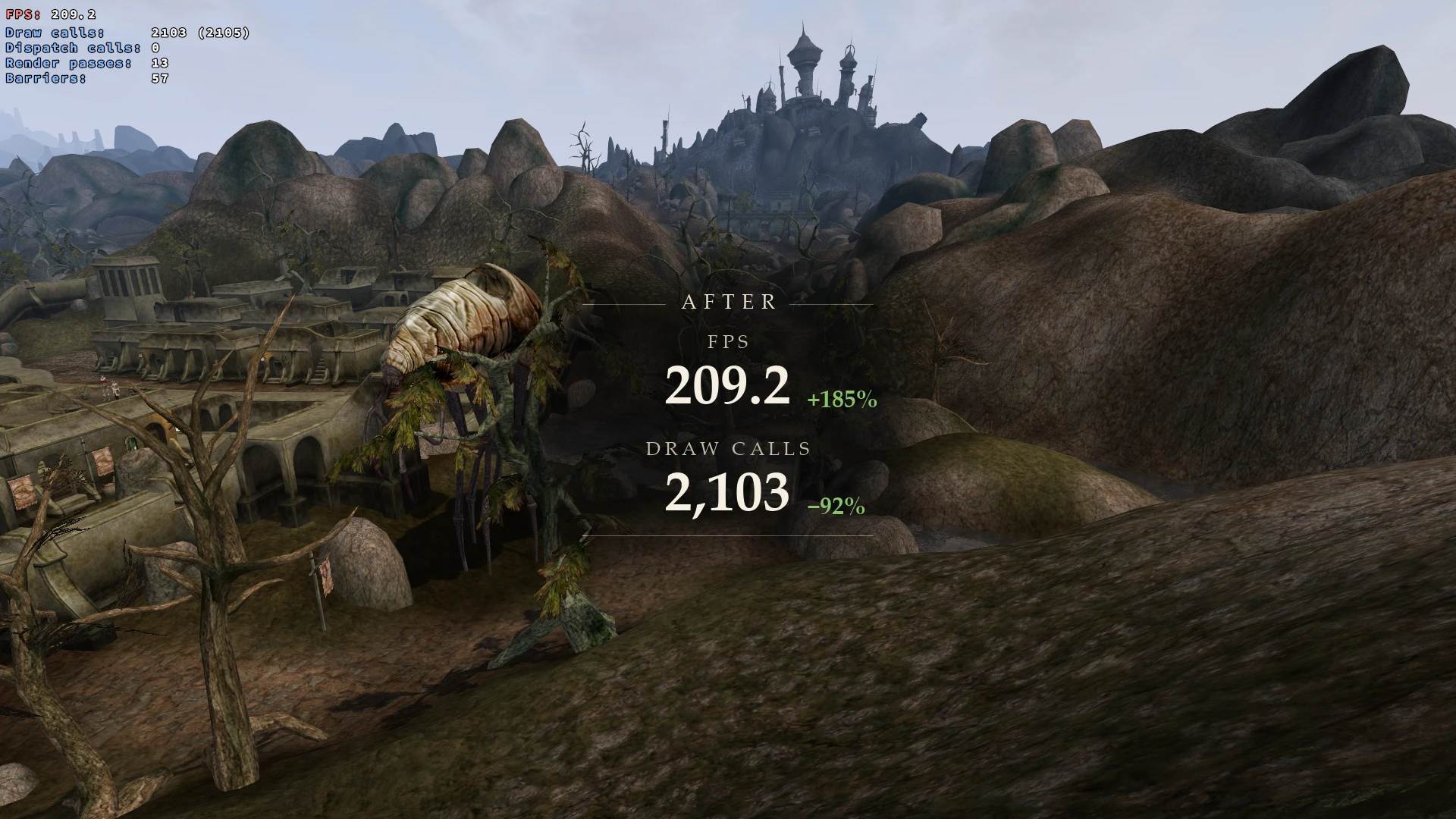
- улучшение фпс (в разы!) (было 70 стало 200, или около того)!
Из "минусов" - отказывается работать на чем-то младше 10ой вынды.
Далее, см. оригинальное ридми:
This is a fork of MGE XE, the graphics extender for The Elder Scrolls III: Morrowind.
It's branched from the prior MGE XE Unofficial Fork and includes features from it.
This is NOT an official MGE XE release. It is my personal fork and it will have rough edges. Please report problems here rather than on the official MGE XE page. The source code is available on Github.
What it does
MGE XE extends Morrowind's visuals with distant land, animated grass, per-pixel lighting, post-process shaders, and much more. It provides a GUI for configuring various graphics-related settings and additionally enables the scripting interface that MWSE Lua mods depend on.
It does not work with OpenMW.
What's different from MGE XE 0.19.1
The primary expected difference is performance. Visuals have been largely untouched and everything should look about the same as prior MGE XE builds. Adding new visuals or features was not the initial goal, but some snuck in and are detailed below.
The majority of changes are oriented around one goal: reducing draw calls.
We do this by:
Optimizing and simplifying objects into "LOD" representations suitable for rendering in a distant scene.
Generating a shared texture atlas and having all objects sample from it rather than their own individual textures.
Merging all objects of each cell into a single instance, which the prior steps' shared atlas makes possible.
Computing visibility data and doing runtime occlusion culling, so cells obscured by landscape do not draw at all.
The end result: Cells that used to cost hundreds or thousands of draw calls now cost one (or zero if occluded). We create the ideal conditions for the GPU: Fewer, large draw calls, where everything is rendered in one pass with all objects sharing the same state, same texture, same shader, same lighting, etc.
On my (9-year-old) machine, with a vanilla install and a 16-cell draw distance, this results in 3x-6x FPS improvement. The better your GPU, the more detailed your mods are, and the larger your draw distance, the more you will benefit. Very large draw distances can see 15x or more FPS improvement. Even very small draw distances will usually see improvements around dense modded cells.
Where it won't help: MGE XE cannot optimize the "active grid" around the player. For that your best option is probably MSOC. MGE XE and MSOC are complementary and work great together, each optimize different scenes. Neither will help in areas where rendering is not the bottleneck, which is often the case for dense cities with large amounts of NPCs (physics, pathfinding, and animation updates dominate).
Other changes
Faster generation
We ask the generator to produce a lot more data than prior MGE XE builds did, but we also made it much faster. It's been rewritten from scratch, is now natively 64-bit (can handle larger installs), and is thoroughly multi-threaded and incremental. Despite doing more work it typically runs full rebuilds around 25x faster than the original MGE XE generator. On my 12-core 3.7 GHz machine, it went from 8m12s to 19s for a full TR+SHOTN+PC install. The more cores you have to throw at it, the larger that difference becomes.
Since generation is now incremental, subsequent modifications after your first generation should be far faster. Typically just a few seconds (depending on what kinds of changes they contain). Automatic change detection and regeneration can now be enabled so you don't have to revisit the GUI after the initial run.
Better landscape detail
The landscape implementation has been rewritten entirely. In prior MGE XE builds the texture quality of landscape would get progressively worse the more landmass mods you installed. With large worlds it dedicated only a few pixels to each entire cell and relied on an overlaid noise texture to fake detail. In this fork, landscape texture quality is much higher and entirely independent of world size. Geometry quality is also improved. Distant landscapes now look basically identical to near ones.
Dark mode GUI
The GUI was rewritten from scratch and now features a dark mode theme while staying faithful to the original layout. Grass mods are auto-detected and displayed in their own list independent of plugins to reduce user mistakes. Across the GUI various new knobs for fine-tuning distant land performance are now available.
TOML configuration
All of MGE XE's configuration settings have been moved to a single mgeXE.toml file in the Morrowind root folder, aligning with other ecosystem tooling. The generator now also detects and auto-loads plugin -metadata.toml files, allowing authors to configure distant land overrides and dynamic visibility for their mods without requiring users to complete complicated, obscure installation steps.
Custom DXVK integration
We now ship (and require) a custom build of DXVK that has been modified to take advantage of Morrowind-specific domain knowledge. This allows us to make various improvements to rendering beyond just distant land optimizations.
Highlights:
Native depth capture allows us to avoid re-drawing the entire scene a second time just for depth information; we now read what's already on the GPU.
Native per-pixel lighting allows us to pass compact lighting data directly to the GPU rather than using slow legacy shader paths, significantly reducing PPL overhead.
Expanded light limits, an optional feature that raises the maximum number of lights that can influence an object from 8 to 32, removing most lighting seams.
Indexed skinning allows us to remove the 4-bones-per-shape limitation and render skinned objects like NPC hands in a single draw rather than dozens.
BC7 texture support, a newer compression format that preserves significantly more detail, providing better compatibility with OpenMW mods.
Requirements (IMPORTANT, READ CAREFULLY)
This release raises the hardware floor a long way over MGE XE 0.19.1. On unsupported hardware the symptom is a crash at launch or a permanent black screen.
64-bit Windows 10 (1809 or later) or Windows 11. Windows 7, 8 and 8.1 cannot run this.
A graphics card compatible with DXVK 3.0:
NVIDIA GeForce GTX 900 series or GTX 750 Ti (Maxwell) and newer.
AMD Radeon RX 5000 series (RDNA) and newer.
Intel Iris Xe (11th generation Core) or Arc and newer.
Graphics drivers from 2023 or newer.
A CPU with SSE4.2, so Intel Nehalem (2008) and AMD Bulldozer (2011) or newer.
The DirectX June 2010 redistributable and the Visual C++ runtime.
8 GB or more of VRAM for large mod lists. Less may work but will require reducing generator settings below the defaults.
SSD and your game data installed on it. Technically not required, but the generation experience will be excruciating without it.
Morrowind Code Patch, needed if you want MWSE.
MWSE 2.1, optional, for Lua mods and the in-game settings menu.
|
|
|
|
мге G7 от 08 2026
32 светильника работают на одной поверхности!
|
269 фпс вместо 49....
Также (новый) билд МГЕ G7 от 08 2026.
|
|
|